
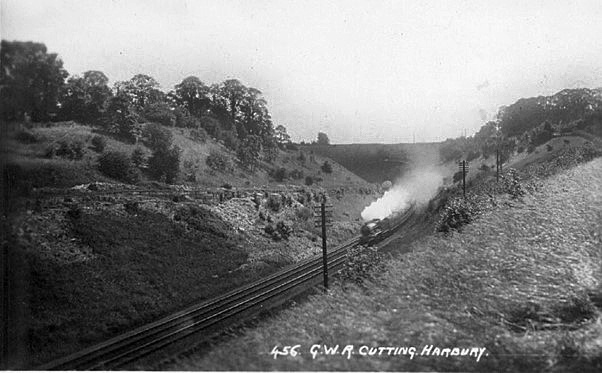
With the coming of the Great Western Railway and its Oxford to Birmingham branch line – the planning and work of the famous engineer Isambard Kingdom Brunel – it was necessary to create a cutting for the line at Harbury, through the geological obstacle of the village with its scarp hill of Lower Lias limestone. This construction took place between 1847 and 1852, with the stretch of land some half a mile long and 110 feet deep. The work was carried out by ‘navvies’ who were paid by the day and, as folklore would attest, were extremely hard working, but often drunk and violent. Liquor and ale were readily available at their campsite and at local inns in the village such as The Crown, which was the nearest establishment to the cutting.
1847 brought an army of workers to the village, and also disquiet. Early in that year, the impact of the navvies’ presence in the village raised concerns about their, ‘…tumultuous, riotous and unlawful behaviour…including violence, theft and the… lawless depredation committed by them…’
It was soon agreed by the villagers that there were insufficient numbers of law officers to support the local constable, P.C. James Harridge, in preserving the peace, with the possible threat of some nine hundred labourers. Southam magistrates were therefore approached in April with an appeal in the form of a ‘Memorial’ (a legal document summarising facts and information relating to a case), a form of petition presented to a legislative body. The Memorial included many telling testimonials:
- Edward Wells, a publican and maltster stated: ‘…a score of railway workers entered my house…abused and threatened us…threatened to break the door down…I would not serve them beer…’
- Thomas Palmer, a butcher and publican declared: ‘…I have witnessed acts of violence committed by these men…they attempted to fight and made a general disturbance…’
- George Garnett, shoemaker and publican added: ‘…they did not pay for one quart of ale…they began to abuse and kick me…’
It was left to P.C. Harridge to present his formal assessment: ‘…I have witnessed acts of violence…I was threatened by men last Sunday night three times…they threatened to murder me…’
In support, the magistrates unanimously agreed to swear in five special constables: Edward Sheasby, Joseph Hawkes, John Wright, John Banbury and John Chapman (all weavers or labourers). For the remainder of that spring tensions improved, but by the August, events took a turn for the worse with further violence and rioting.
What concerned Harbury was also apparent in nearby villages including Offchurch, where four navvies assaulted the landlord of The Stag Inn, Thomas Whitehead. On June 26th 1847 the navvies, having drunk a gallon of ale without paying, brutally attacked Thomas for refusing them more drink. Despite their denials in court the men were convicted and imprisoned in the House of Correction at Warwick for six months with hard labour, as an example: ‘…to protect subjects to repeated depredations and outrages…from men employed upon the railways…’
It was, perhaps, a warning for those men working in Harbury, as was to become apparent later that summer.
(To be continued next month)
Southam Heritage Collection is located in the atrium of Tithe Place opposite the Library entrance. Opening times Tuesday, Thursday, Friday and Saturday mornings from 10am to 12 noon – holiday dates/times available on Google or www.southamheritage.org. To find out more about Southam’s history, visit our website www.southamheritage.org telephone 07710 012052 or email southamheritage@hotmail.com You can also follow us on Facebook.
Leave A Comment