
‘…Damn you…if you make the least noise, I’ll fire at you…’
So shouted John French as he knocked his victim, William Cole, to the ground in a field beside the turnpike road at Chapel Ascote in September 1828, having taken from him his watch, some silver and three sovereigns. It was a brutal crime that would have its consequences later, as would other felonious acts committed in the Southam area in the first half of the nineteenth century.
An equally traumatic example of highway robbery occurred some years later in December 1849, when a poor woman, Mary Poultney, was accosted just outside Long Itchington by two men who, aware she was alone, seized and searched her, finding a half-sovereign. Mary had been on her way to Southam to visit her daughter in the Southam Union Workhouse. She had planned to spend Christmas in the town. The two assailants, Thomas and Charles Stone, brothers in their early twenties, quickly disappeared along the turnpike road towards Coventry.
The brothers were identified as labourers working on the railway at Birdingbury, who had spent that afternoon drinking in a Long Itchington inn. They were soon apprehended and brought before the Southam Petty Session on Christmas Day, before the magistrate William Taylor. Initially committed to Warwick Assizes, they were sentenced to ten years transportation to Australia.
Similarly, in March 1834, Charles Hull was robbed of two guineas and some silver just outside Southam, his assailant William Smith threatening to ‘…blow your brains out…if you cause a problem…’ Smith was apprehended, transferred to Warwick Gaol and then to the hulk York at Gosport, before being transported to Australia for seven years.
Inevitably, sometimes felons managed to escape justice. This was the case in Ufton in December 1842 when a Mr Turner from Napton was set upon by two men dressed as labourers, whilst returning on his horse from Warwick market. He was pulled off his horse, struck on the head and cut on the hand with a knife before being robbed of his purse containing seven £5 notes and thirty-six sovereigns. He was able to travel on to Southam where he alerted Inspector Smallbones, but to no avail, as the robbers had ‘disappeared.’
The robbery of William Cole at Chapel Ascote involved two assailants, James Varney, aged twenty, from Bicester and John French, aged twenty-three, from Brackley. They had travelled some distance before chancing upon Mr Cole on the turnpike road between Fenny Compton and Ladbroke at about seven in the evening, when he had asked them for directions to Ladbroke. Offering to show him the way, the felons misled him into a field before knocking him to the ground, tying his hands and rifling through his pockets.
Some astute police work by Constable Thompson of the Banbury police soon led to the apprehension of the two villains, who were found with their spoils at the house of Varney’s parents in Bicester. At Warwick Assizes in April 1829 the two young men were found guilty and executed for their crimes. It was doubtless the case that under the Bloody Code (introduced in 1688), the magistrates interpreted their crime as ‘highway robbery’ (with the robbery and aggravated violence), which carried the mandatory death sentence, although by 1823 under the Judgement of Death Act, their decision could have been more discretionary.
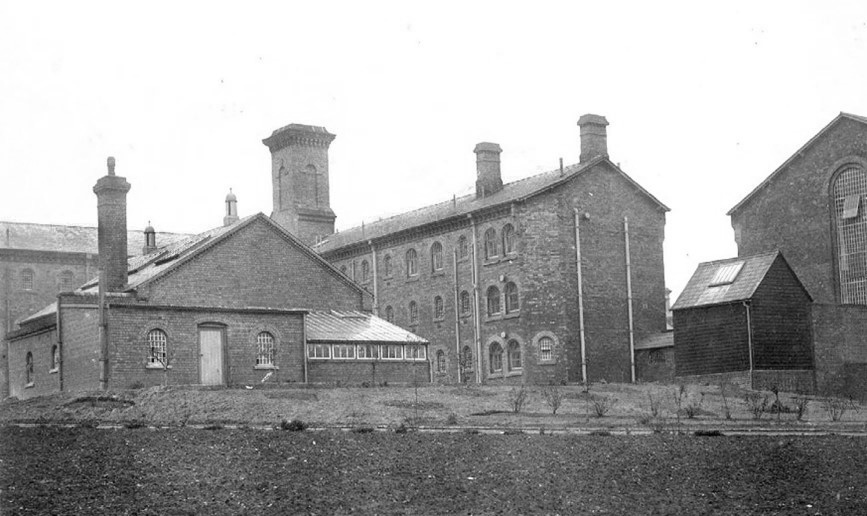 Warwick Gaol: “Reproduced from “Our Warwickshire” website” @WCRO 2902/84, img, 10263
Southam Heritage Collection is located in the atrium of Tithe Place opposite the Library entrance. Opening times Tuesday, Thursday, Friday and Saturday mornings from 10am to 12 noon. To find out more about Southam’s history, visit our website www.southamheritage.org telephone 07710 012052 or email southamheritage@hotmail.com You can also follow us on Facebook.
Leave A Comment