
Between 1787 and 1868 it is estimated that 160,000 convicts were transported to Australia, their average age being twenty-six. Most were charged with theft, often of small items. A typical example was the case of James Clifford, aged twenty-three, a labourer who stole a lump of cheese worth 4s 2d. At the trial in December 1852, the plaintiff’s deposition reflected the strange nature of the case:
‘…about three o’clock…I was in my shop and received information that a boy had stolen a cheese…I ran out and at the corner of the Black Dog stable gate I came up with the prisoner…Clifford who was eating cheese. I said, “What are you doing with my cheese?” He said he took it because he was hungry…I took him to the lock-up…Inspector Smallbones charged him with theft…the prisoner repeating, “I was hungry.”
James Clifford was sentenced to seven years transportation.
In the previous year Thomas Adams, (47), and his two daughters, Elizabeth (18) and Ann (15) were committed to trial charged with receiving, whereby they:
‘…in Southam feloniously received from Thomas Stanton and James Parrot a £10 Bank of England note, the property of Thomas Sutton, well knowing it to have been feloniously stolen…Elizabeth and Ann acquitted…Thomas Adams sentenced to ten years transportation…’
It was not many years after this, following criticism and attempts at reform, that transportation was replaced by the sentence of ‘penal servitude’ after Parliamentary Acts of 1853 and 1857.
Although the law changed earlier, transportation finally ended in 1868, for many reasons: the conditions of the prisoners were viewed as inhumane; ratepayers objected to the fact that they had to support the families of the convicts; and the Australian authorities objected to the frequency with which convicts were entering their country.
In one of the final cases from Southam, John Bishop (24), a labourer, was indicted in June 1850 for stealing two ‘alpaca’ coats belonging to two drapers. A butcher from Dunchurch, John Barford, witnessed one of the crimes:
‘…I was sitting in the door of Mrs Bloxham’s house…I saw the prisoner take a coat which was hanging outside the front of Mr Graves’ shop…the prisoner put the coat on under the one he was wearing…’
Bishop admitted his guilt while being searched by Inspector Smallbones. Unbuttoning his trousers, he revealed:
‘…Here you may as well take the other, for I know you will find it…’
He was sentenced to seven years transportation.
The final case occurred on January 25, 1853, when two men, John Gallochan (24) and Thomas White (26), were indicted for the theft of forty pounds of lead and a copper vessel from the locked yard of Fredrick Welchman. The case rested on the evidence of William Presidge, a dealer in old metal, who testified:
‘…the prisoners …produced some lead and copper out of a bag asking what I would give for them…I told him 6d for the lead and 3 1/2d for the copper vessel…’
Despite the suspects’ denials, the metals were identified as the stolen items and the prisoners, having no credible defence, were transported for seven years.
So ended the story of transportation of criminals from Southam.
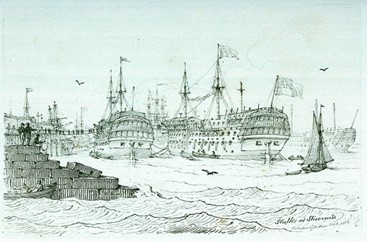
Hulks at Sheerness by Henry Moses: Royal Museum Greenwich: Picryl image, public domain
Southam Heritage Collection is located in the atrium of Tithe Place opposite the Library entrance. Opening times Tuesday, Thursday, Friday and Saturday mornings from 10am to 12 noon. To find out more about Southam’s history, visit our website www.southamheritage.org telephone 07710 012052 or email southamheritage@hotmail.com You can also follow us on Facebook.
Leave A Comment