
After the season of festive celebration and sometimes excess, reflection on the drinking habits of previous centuries reveals similar anti-social behaviour under the influence of alcohol at any time of the year.
In 1873, Inspector Henry Walker in Southam was fully employed in dealing with a comprehensive list of crimes, including larceny, begging, violence, vagrancy, house breaking, deserting fathers and ‘casual paupers’ from the workhouse who sometimes refused to comply with the rules. Of course, added to these were the incidents in the town’s inns: assault, breach of the peace, drunken and riotous behaviour and those refusing to leave. Included in any list, of course, was often the attitude of innkeepers, as illustrated by the case of John Stephens, licensee of the Black Dog in 1873.
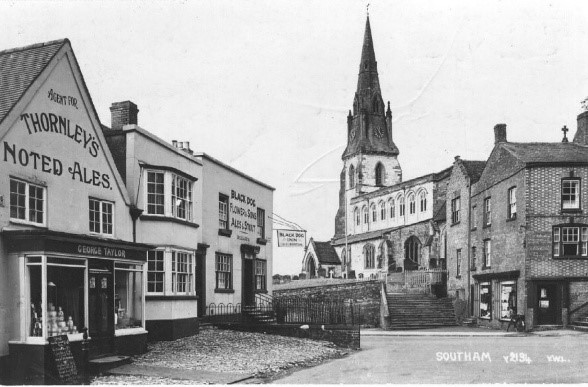
On October 14 of that year, Inspector Walker was called to the inn and ‘…found gipsies and strangers in the house at 11 a.m., some the worse for drink…later they were still there…’ When he called again at 3 p.m. he found what he described as riotous behaviour. Despite remonstrating with Stephens, he was ignored and the innkeeper continued to supply ale until closing time.
Stephens was charged with permitting drunkenness on his premises and fined £10 with 10s costs. Such a high fine was partly due to the newly imposed Licensing Acts of 1869 and 1872, whereby the issue of licences was assigned to magistrates instead of being a local parish responsibility. Recognising a national problem, the legislation deemed it, ‘…an offence to permit drunkenness or any violent, quarrelsome or riotous conduct…’
However, despite the tightening of the law, at the ensuing court ‘Special Session’ for the issuing of licences in September 1874, Stephens was allowed to keep his licence. In a further twist, the owners of the Black Dog recorded their support of him, claiming he had improved the conduct of the inn. He was allowed a further twelve months’ grace – perhaps indicative of ‘business power!’
In the 1880s Inspector Jesse Welch was faced with a different set of circumstances in his support of Mr French, the innkeeper of the Red Lion, who had to deal with a series of recalcitrant and violent individuals. Problems began in March 1881 when a young man from Stockton, Alfred Sargeant, was charged with disorderly conduct, refusing to leave the inn, acting violently and using abusive language to the landlady. It was reported that the defendant was one of several young men who were in the habit of visiting Southam from local villages on a Sunday night and being troublesome.
In the same year Charles Poulton, a labourer, was charged with disorderly behaviour and refusing to quit the inn, besides using ‘…the foulest language ever heard…’. He was fined £2 with 14s 6d costs, with the threat of future imprisonment.
In 1883, the Assize Court in Warwick had to deal with Henry Bond, a labourer, for assaulting a Mrs Hodges and knocking down her son who had gone to help her. There being no excuse other than that he was drunk and disorderly, he was fined 10s with costs of 13s 6d.
These are but a handful of examples that arose over the decades through the problems of ‘irresponsible drinking’.
Southam Heritage Collection is located in the atrium of Tithe Place opposite the Library entrance. Opening times Tuesday, Thursday, Friday and Saturday mornings from 10am to 12 noon. To find out more about Southam’s history, visit our website www.southamheritage.org telephone 07710 012052 or email southamheritage@hotmail.com You can also follow us on Facebook.
Leave A Comment