
At the Southam Petty Sessions on May 1, 1865, a number of individuals were brought before the court to face conviction for their crimes, including:
‘…Samuel Bodger for assaulting Thomas Smith, convicted, fined 10s with 12s 6d costs…’
‘…Joseph Bodger for assaulting Jonathan Rollason, convicted, fined 10s with 12s 6d costs…’
‘…James Cave for assaulting Jonathan Rollason, convicted, fined 10s with 11s costs…’
‘…George Warwick for assaulting Sarah Berry, convicted, fined with 10s costs…’
Each of the above faced two months in gaol with hard labour if they did not comply with the court order. The sentences were considered to be comparatively high as, only some twenty years before, the majority of assault cases were either settled out of court or dismissed by the magistrates. In 1843 there were fifteen court cases presented as assaults, yet only three of these resulted in a conviction. The remaining twelve were settled out of court, with the alleged assailants only having to pay court costs.
This is particularly interesting as, under the Waltham Black Act of 1723 (The Bloody Code), some two hundred offences carried the death penalty. Nevertheless until 1851, the crime of assault was largely considered to be a civil matter where any resolution was often an informal agreement between the parties with some compensation being paid to the plaintiff. This was particularly so in rural areas, as the local parish constables and justices of the peace were only elected as volunteers and were, perhaps, insufficiently qualified to pass legal judgements.
Typically, if an assailant was drunk – and no other evidence was available – the magistrate might have accepted the defence of provocation or having lost self-control in the ‘heat of blood’ (even if alcohol-induced). If a knife was involved, an assailant could have claimed to have been provoked whilst eating! A successful prosecution relied upon an active victim determination to see justice done, as on May 1, 1843, when:
‘…Richard Bates appeared to answer the case of assault on Mary Rainbow, with witnesses, convicted, fined £5 with costs…’
and, in 1849:
‘…Daniel Jones accused and convicted of assault on William Masters, fined 50s with 15s 6d costs…if in default of immediate payment to be committed to the House of Correction at Warwick…’
Usually cases went the other way, as on June 5, 1843, after an assault on Richard Boffin, Inspector Smallbones reported that the alleged assailants, James Boffin, James Woodward and John Malin, had agreed to settle with the plaintiff out of court. This was known legally as ‘compounding’. In a different way, a violent husband could undergo retribution by means of ‘rough music’ – neighbours creating a disturbance outside his home.
It was only after 1851, with the Prevention of Offences Act, that assault was treated more severely, whereby ‘unlawful or malicious infliction of grievous bodily harm, with or without weapon’ could be punishable by three years in prison with hard labour. It was certainly a deterrent, as in Southam cases of assault were abruptly curtailed.
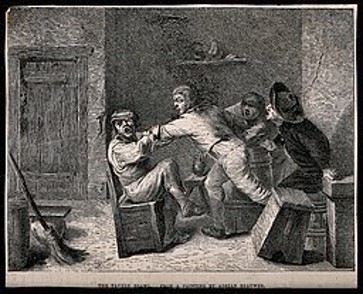 A Drunken Brawl; nineteenth century wood engraving after Adrian Brauwer. Welcome image, creative commons, Wikimedia commons
Southam Heritage Collection is located in the atrium of Tithe Place opposite the Library entrance. Opening times Tuesday, Thursday, Friday and Saturday mornings from 10am to 12 noon. To find out more about Southam’s history, visit our website www.southamheritage.org telephone 07710 012052 or email southamheritage@hotmail.com You can also follow us on Facebook.
Leave A Comment