
The transportation of criminals dates back to 1601, when they were first sent to the British colonies in America and the Caribbean islands; however, once the USA had become an independent nation from Britain in 1776 after the American War of Independence, felons could no longer be sent there.
There is evidence of criminals being transported from Warwickshire recorded as early as 1767 when a ‘transportation bond’ was made between John Beardsley, the Clerk of the Peace for Warwickshire and three Bristol merchants, Samuel Sedgely, William Hillhouse and William Randolph, who agreed to transport Thomas Munger, a sheep thief, John Powell, thief of a gold watch, John Chambers, house thief, John Cherrington, thief and Mary Snape, condemned for ‘stealing wearing apparel’, with a contract worth £500. It is probable that the convicts would have travelled from Bristol to Maryland, where they would have been sold as slaves to work on tobacco plantations along with thousands of enslaved Africans.
As prisoners could no longer be sent to America after 1776, once Captain James Cook claimed Australia as a colony of Britain in 1770, criminals began to be sent there as forced labour. Transportation was seen as a suitable punishment as hanging became regarded as too extreme and the cost of prisons was seen as very expensive. There was the use of ‘hulks’ – old warships anchored on the River Thames – but these generally became overcrowded and rife with diseases such as typhus. Finally, many felt that sending prisoners away and forcing them to work could provide them with new skills and the chance to reform themselves.
Perhaps the most famous historical example of transportation relates to the Tolpuddle Martyrs, six agricultural labourers from Dorset who in 1834 were convicted for swearing an oath as members of the ‘Friendly Society of Agricultural Labourers’, which at the time contravened the Unlawful Oaths Act, during a dispute over the cutting of wages. They were eventually pardoned and allowed to return to England between 1837 and 1839.
In Southam, the first recorded example of such punishments occurred in 1829 and related to Robert Williams (alias White), aged forty-two:
‘…having feloniously stolen at Southam on March 27, two pairs of shoes the property of Henry Lilley Smith and one shawl the property of his servant…sentenced to seven years transportation…’
On 6 October 1837, the magistrates at Southam’s Quarter Session passed a guilty judgement upon John Reading, aged thirty-seven, who during an altercation:
‘…in the parish of Southam unlawfully and maliciously stabbed Thomas Foster just below the pit of the stomach and also in his right thigh with the intention of grievous bodily harm…sentenced to transportation for life…’
A similar fate awaited many others in the villages around Southam, including Richard Cashmore, aged twenty-eight, of Long Itchington, who in 1829 was transported for theft and sentenced for seven years, while in 1837 a much harsher sentence was handed to James Smith, aged twenty-eight of Harbury, who was transported for life for stealing a sheep.
(To be continued next month)
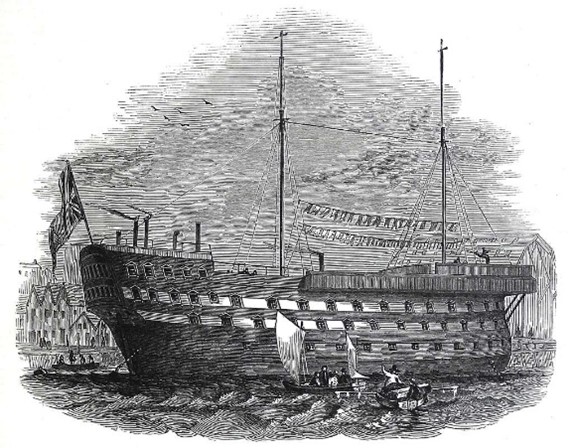
The Warrior, a Convict Hulk at Woolwich on the Thames, 1846. Picryl image.
Southam Heritage Collection is located in the atrium of Tithe Place opposite the Library entrance. Opening times Tuesday, Thursday, Friday and Saturday mornings from 10am to 12 noon. To find out more about Southam’s history, visit our website www.southamheritage.org telephone 07710 012052 or email southamheritage@hotmail.com You can also follow us on Facebook.
Leave A Comment